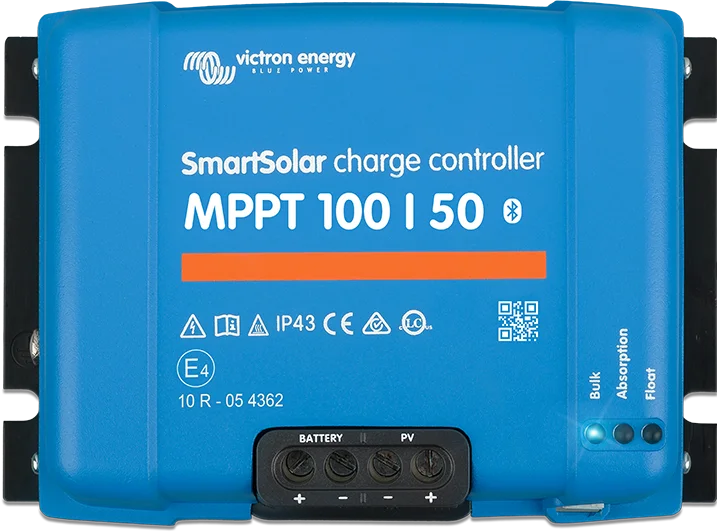
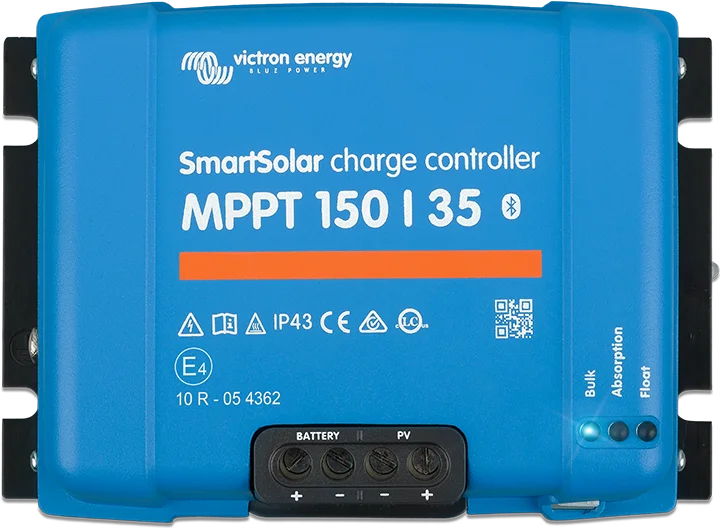
We test and compare the top solar charge controllers from Victron, Renogy, EPever, and more. Every MPPT and PWM controller is scored on efficiency, features, value, and build quality — with real specs, not marketing hype.
MPPT vs PWM charge controller: what is the difference?
MPPT (Maximum Power Point Tracking) controllers convert excess solar panel voltage into additional charging current, achieving 20-30% higher efficiency than PWM. PWM (Pulse Width Modulation) controllers simply match panel voltage to battery voltage, wasting the difference as heat. MPPT is the better choice for any system over 200W or when panels operate at a higher voltage than the battery bank.
How do I size a solar charge controller?
Divide your total solar array wattage by your battery bank voltage to get the minimum amperage rating. For example, 400W of panels on a 12V bank requires at least a 33A controller — so a 40A unit provides safe headroom. For MPPT controllers, also verify that your panel array open-circuit voltage (Voc) does not exceed the controller maximum input voltage, especially in cold weather when Voc rises.
Are solar charge controllers compatible with LiFePO4 batteries?
Most modern MPPT controllers support LiFePO4 with a dedicated charging profile that uses the correct absorption voltage (14.2-14.6V for 12V banks) and no float stage or a reduced float. Always confirm your controller has a specific LiFePO4 or user-programmable profile — using a standard lead-acid profile can undercharge or damage lithium cells over time.